Price
$435.73
In stock
|
COOKIES SETTINGS |
Accept all cookies Personalise |
| Accept selected cookies |


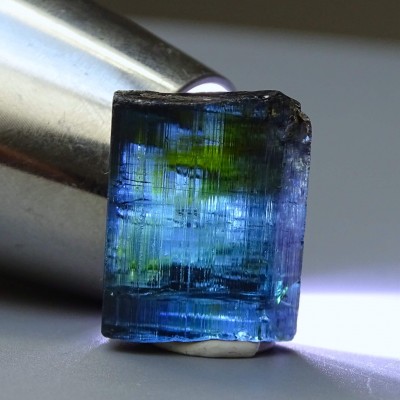
Tourmaline is not a single mineral, but a large group of chemically related borosilicates with highly variable compositions. Individual tourmaline species may contain iron, magnesium, sodium, lithium, calcium, manganese and other elements. This complex chemistry is responsible for the exceptionally broad range of colors, including black, brown, green, blue, pink, red, yellow and multicolored crystals.
Tourmalines typically form elongated prismatic crystals with pronounced longitudinal striations. Their cross-sections are often triangular to rounded triangular. Some crystals display strong color zoning, with shades changing from the center toward the outer edge or along the length of the crystal. A well-known example is watermelon tourmaline, which has a pink center surrounded by a green outer zone.
The best-known members of the tourmaline group include black schorl, brown to yellow-brown dravite, colorful elbaite and strongly zoned liddicoatite. Transparent colored tourmalines are used as gemstones, while well-developed crystals, druses and crystals embedded in their host rock are valued as mineralogical specimens.
| Name | Tourmaline |
| Mineral group | Tourmaline group, boron-bearing cyclosilicates |
| General composition | Complex borosilicates containing Na, Ca, Li, Mg, Fe, Mn and Al |
| Crystal system | Trigonal |
| Color | Black, brown, green, blue, pink, red, yellow, colorless and multicolored |
| Hardness | 7–7.5 on the Mohs scale |
| Density | Approximately 2.9–3.3 g/cm³, depending on composition |
| Luster | Vitreous |
| Transparency | Transparent, translucent to opaque |
| Cleavage and fracture | Indistinct cleavage, uneven to conchoidal fracture |
Tourmalines form in several geological environments, but they are especially common in boron-rich granitic pegmatites. Boron, which is essential for tourmaline formation, becomes concentrated in residual melts and hydrothermal fluids during the final stages of magma crystallization. Under these conditions, large and well-developed crystals may grow.
Tourmaline also occurs in metamorphic rocks such as gneiss, mica schist and marble. Black schorl is a common component of granites and pegmatites, whereas dravite forms more frequently in magnesium-rich rocks. Lithium-bearing elbaites are especially characteristic of highly evolved pegmatites.
Changes in chemical composition during crystal growth produce color zones. A single crystal may therefore contain several colors or gradual transitions between them. Tourmaline is also pyroelectric and piezoelectric, meaning that electrical charges may develop at its ends when the crystal is heated, cooled or subjected to mechanical pressure.
Tourmaline occurs at numerous localities around the world. Individual deposits differ in chemical composition, color, crystal size and overall specimen quality.
Tourmaline is a group of complex borosilicate minerals with variable chemical compositions and an exceptionally broad range of colors.
Its color is influenced mainly by iron, manganese, chromium, vanadium and other elements, as well as by crystal-structure defects and natural irradiation processes.
Black tourmaline is usually schorl, an iron-rich member of the tourmaline group and one of its most widespread species.
Watermelon tourmaline is a color-zoned crystal that usually has a pink to red center surrounded by a green outer zone.
Tourmaline has a hardness of 7 to 7.5 on the Mohs scale, making it sufficiently durable for cutting and use in jewelry.
No. Gem-quality elbaites may be transparent, while schorl and some other tourmaline species are usually opaque.
You always purchase the exact mineral shown in the photograph. Minerals-stones.com – a wide selection of minerals, crystals, stones, tektites, jewelry and gemstones from around the world. A reliable and verified international online store, with all items in stock and ready for immediate dispatch.
There are 45 products.