Price
$157.73
In stock
|
COOKIES SETTINGS |
Accept all cookies Personalise |
| Accept selected cookies |


Amethyst is a natural violet to purple variety of quartz with the chemical formula SiO₂. It is one of the best-known gemstones and collector minerals in the world. Its colour range extends from very pale lavender through pinkish violet and bluish violet to deep, intensely purple shades.
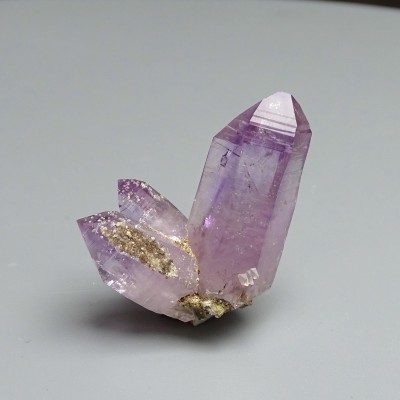
The violet colour of amethyst is associated with small quantities of iron within the crystal structure of quartz and the subsequent effect of natural ionising radiation in the surrounding rock. The colour may be distributed evenly throughout the crystal, but it often forms lighter and darker zones. In some crystals, the most intense violet colour is concentrated mainly in the crystal tips.
Amethyst may be completely transparent, translucent or almost opaque. It occurs as individual crystals, crystal groups, clusters, geodes, vein fillings or as part of the original matrix rock. In addition to small crystals suitable for jewellery, enormous amethyst geodes several metres high can also form.
The combination of distinctive colour, good hardness, vitreous lustre and a wide variety of natural forms makes amethyst one of the most sought-after minerals for collections, interior decoration, jewellery production and gemstone cutting.
| Mineral group | Quartz |
| Chemical formula | SiO₂ |
| Mineral class | Oxides |
| Crystal system | Trigonal |
| Colour | Lavender, pinkish violet, violet to dark purple |
| Hardness | 7 on the Mohs scale |
| Density | Approximately 2.65–2.66 g/cm³ |
| Refractive index | Approximately 1.544–1.553 |
| Lustre | Vitreous |
| Transparency | Transparent, translucent to opaque |
| Cleavage | None |
| Fracture | Conchoidal to uneven |
| Streak | White |
| Uses | Gemstones, jewellery, crystal clusters, geodes, collector specimens and decorative objects |
Amethyst is a crystalline variety of silicon dioxide and mineralogically belongs to the same group as rock crystal, citrine, smoky quartz, rose quartz and other coloured quartz varieties. Its basic chemical composition is the same as that of other quartz varieties, but its distinctive appearance is produced by trace elements, colour centres, growth conditions and subsequent geological processes.
Amethyst crystals have trigonal symmetry and usually form six-sided prismatic shapes terminated by rhombohedral faces. In crystals growing inside geodes, the prismatic sections are often very short and the pointed terminations are the most prominent feature. In vein deposits, amethyst may also form elongated individual crystals, sceptre-shaped crystals or crystals growing on an older generation of quartz.
Amethyst has no distinct cleavage, but it may break with a conchoidal fracture similar to glass. A hardness of 7 on the Mohs scale means that it is more resistant than many common minerals, although it can still be scratched by harder materials such as topaz, corundum and diamond.
Natural amethyst commonly displays so-called Brazil-law twinning, in which very thin regions of right-handed and left-handed quartz alternate inside the crystal. This characteristic can be important when professionally distinguishing certain natural stones from synthetic material.
Amethyst can form in several geological environments, but it generally crystallises at relatively low temperatures and at shallower levels of the Earth’s crust. The best-known amethyst geodes form within cavities in volcanic rocks, particularly former gas bubbles inside basaltic lava flows.
After the lava solidified, hydrothermal fluids rich in silicon dioxide began circulating through the cavities. A layer of chalcedony or agate could first form on the inner walls, followed by quartz crystals growing towards the open space. When suitable trace elements and geological conditions were present, some of the crystals developed the characteristic violet colour of amethyst.
This process created the extensive geode deposits of southern Brazil and Uruguay. Their outer surface consists of relatively inconspicuous volcanic rock, while the interior may be covered with thousands of violet crystals. Some geodes are only a few centimetres across, while others reach human height or form massive cathedral-like structures.
Amethyst also occurs in hydrothermal veins, fractures, pegmatites and certain metamorphic environments. In these deposits, it may form individual crystals, crystal groups, sceptre crystals or intergrowths with rock crystal and smoky quartz.
The final appearance of amethyst depends on temperature, the chemical composition of the mineralising fluids, growth rate, iron content, the intensity of natural radiation and the geological history of the individual locality.
The violet colour of amethyst is produced by the combination of small quantities of iron within the quartz crystal structure and the effect of natural ionising radiation. Iron may replace some silicon atoms in the crystal, while subsequent irradiation creates colour centres that absorb certain wavelengths of visible light.
The colour may be concentrated in crystal tips, growth zones or irregular sectors. Clearly defined lighter and darker violet areas are therefore common in natural amethyst.
The colour of amethyst ranges from very pale lavender through pinkish violet and bluish violet to deep purple. In faceted gemstones, an intense violet to slightly reddish-violet colour without a pronounced brown or grey undertone is generally regarded as especially desirable.
An excessively dark amethyst may appear almost black under normal lighting and may not return sufficient light. A very pale stone, by contrast, may show only a faint violet tint. Value therefore depends not only on colour intensity, but also on colour purity, evenness and the overall appearance of the stone.
Colour zoning is typical of amethyst. When cutting a faceted gemstone, the cutter tries to orient the rough so that the finished stone appears as evenly coloured as possible. In natural crystals and clusters, however, visible zoning may be desirable because it reveals the growth history and emphasises the natural character of the specimen.
Clarity is assessed according to the quantity and visibility of inclusions, fractures and cloudy areas. Gem-quality amethyst can appear very clean to the unaided eye. Collector crystals may contain growth lines, fluid inclusions, haematite, goethite and other mineral inclusions that create unusual visual varieties.
In crystal clusters and geodes, quality is also determined by crystal size, lustre, density of crystal coverage, shape of the cavity, stability of the matrix, damage to the points and the overall aesthetic composition.
Brazil is one of the world’s most important producers of amethyst. The Rio Grande do Sul region is particularly famous for large amethyst clusters, geodes and cathedral formations created inside cavities in volcanic rock. Brazilian amethysts may have pale to medium violet colour and frequently form large decorative specimens.
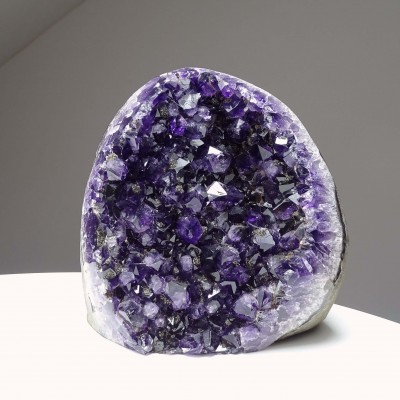
Uruguay is renowned for amethyst clusters and geodes containing smaller, highly lustrous and often exceptionally dark violet crystals. Their intense colour, contrasting agate matrix and strong lustre make Uruguayan amethysts highly sought-after collector minerals.
Zambia produces significant quantities of gem-quality amethyst valued for its saturated violet colour and suitability for cutting. Amethysts from Namibia are also well known, particularly specimens from the Brandberg region, where attractive crystals combine amethyst and smoky quartz colour zones.
Characteristic amethysts also come from Mexico, including long, pale to medium violet crystals from the Veracruz region. Specimens from Guerrero are known for slender crystal forms with more intensely coloured tips.
Other important deposits are found in Bolivia, Russia, Madagascar, Morocco, Canada, the United States, India, South Korea, Australia and many other countries.
An amethyst cluster is a section of rock whose surface is covered with interconnected amethyst crystals. A geode is a hollow or partly hollow rock formation whose inner walls are lined with crystals. When a geode is tall, elongated and resembles the entrance to a cathedral after being cut open, it is commonly described in the trade as an amethyst cathedral.
The exterior of a geode often consists of dark volcanic rock. Moving towards the centre, layers of agate, chalcedony and pale quartz may be followed by the amethyst crystals themselves. Secondary minerals such as calcite or goethite may also grow on top of the amethyst.
The quality of a cluster is assessed according to the intensity and evenness of its violet colour, crystal lustre, undamaged points, size, shape, stability of the matrix and overall aesthetic appearance. In large geodes, the quality of the cut, structural stability of the rock and secure standing position are also important.
Natural fractures, colour zones, contact areas with the matrix and minor irregularities are not automatically defects. They are natural features of mineral formation that distinguish a genuine geological specimen from an industrially manufactured decorative object.
The collector value of amethyst is not determined solely by the intensity of its violet colour. The locality, crystal form, quality of the terminations, preservation of edges, lustre, transparency, presence of matrix and association with other minerals are also important.
Perfectly terminated individual crystals, sceptre amethysts, double-terminated crystals, unusual intergrowths, phantom crystals and specimens containing natural inclusions may be particularly valuable. Crystals combining violet amethyst with smoky quartz or colourless rock crystal are also highly attractive.
The collector value of clusters and geodes depends on their size, colour, completeness, lustre and overall composition. A smaller Uruguayan cluster with exceptionally saturated colour may be more valuable than a much larger but very pale and damaged specimen.
Documented origin also plays an important role. A precisely stated locality increases both the informational and collector value of a mineral and makes it possible to compare the characteristic features of individual deposits.
Natural amethyst cannot be identified reliably by violet colour alone. It may be imitated by coloured glass, synthetic corundum, synthetic spinel, violet fluorite or laboratory-grown synthetic amethyst.
Professional identification may involve measuring refractive index, birefringence, density and optical character, together with examining internal structures using a loupe, microscope or polariscope. Natural amethyst may show angular colour zoning, Brazil-law twinning, growth lines, fluid inclusions and small mineral inclusions.
Coloured glass may contain rounded gas bubbles or swirling structures and has different hardness and optical properties. Violet fluorite is significantly softer, has perfect cleavage and a different density. Distinguishing synthetic amethyst can be considerably more difficult because it has the same chemical composition and very similar physical properties to natural amethyst.
For more valuable faceted stones, unusually large and clean specimens or stones presented as natural and untreated, professional gemmological examination or a laboratory certificate is recommended.
Synthetic amethyst is produced by the hydrothermal method and may possess virtually the same chemical, physical and optical properties as natural amethyst. Assessment based only on colour and clarity may therefore be insufficient for reliable identification.
Identification may require examination of twinning, growth structures, inclusions and other characteristics using gemmological instruments. The term “synthetic” does not mean a glass imitation; it describes laboratory-grown material with the crystal structure of quartz.
Heat treatment is the most common treatment applied to amethyst. Heating can lighten an excessively dark violet colour, reduce certain brownish tones or change the colour completely.
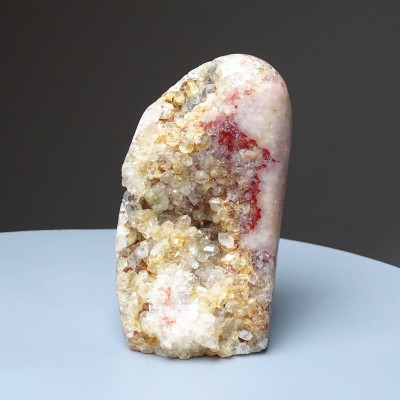
Some amethysts change to yellow, orange or brownish-orange when heated. This material is commonly sold on the market as heat-treated citrine. Natural citrine and heated amethyst share the same basic chemical formula, but their geological origin and colour-forming processes are different.
Strongly orange to rusty-brown clusters with a pale or whitish base are often heat-treated amethyst. Such material should be correctly described as heat-treated rather than presented as rare natural citrine.
Excessive heating may weaken, remove or alter the violet colour of amethyst. Amethyst should therefore not be exposed to high temperatures, and home heat-treatment experiments are not recommended.
Amethyst jewellery should be stored separately from harder stones such as sapphire, ruby and diamond. At the same time, amethyst can scratch softer minerals, so a separate compartment, soft fabric pouch or jewellery box is recommended.
Clusters and geodes should be placed on a stable, level and sufficiently strong surface. Large amethyst cathedrals can be very heavy and must be secured against tipping over. When carrying them, hold the solid matrix rather than the crystal points.
Dust can be removed from clusters using a soft brush or a gentle stream of lukewarm water. Do not use hard brushes, abrasive powders or metal tools that could damage the lustrous crystal surfaces.
To preserve the colour over the long term, store amethyst away from direct intense sunlight, radiators, fireplaces, powerful light sources and other locations with high or fluctuating temperatures.
The name amethyst comes from the ancient Greek word amethystos, which may be translated as “not intoxicated” or “protecting against drunkenness”. In ancient Greece and Rome, people believed that amethyst, or a vessel made from amethyst, could protect against the effects of alcohol. This is a historical tradition rather than a scientifically demonstrated property of the mineral.
Amethyst was used by ancient civilisations to produce beads, seals, engraved gems, amulets and decorative objects. Its violet colour was long associated with power, dignity, spiritual authority and high social status.
In medieval and early modern European jewellery, amethyst was used in ecclesiastical rings, coronation objects, vessels, carvings and royal art collections. The development of major South American deposits later increased its availability considerably without reducing its popularity.
Today, amethyst is valued primarily as a natural gemstone, collector mineral and decorative stone. Historical legends and cultural symbolism form part of its story, but they should not be confused with medical or health-related effects.
The value of faceted amethyst is influenced mainly by colour, colour distribution, clarity, weight, dimensions, cutting quality and overall appearance. The most highly valued stones generally display a strong violet to reddish-violet colour that is not excessively dark and remains clearly visible under ordinary lighting.
Gem-quality amethyst should have a high-quality polish, good symmetry and a cut adapted to the colour distribution within the rough material. A cut that is too shallow or incorrectly oriented can make the stone appear extremely pale or, conversely, almost black and opaque.
For collector crystals, clusters and geodes, the locality, colour intensity, size and lustre of the crystals, undamaged terminations, quality of the matrix, dimensions, weight and overall aesthetic appearance are assessed. An exceptional crystal from a highly regarded locality may have significant value even when relatively small.
The price of large geodes also depends on stability, cutting quality, symmetry of the cavity, thickness of the agate layers, the possibility of secure display and the complexity of transport.
Amethyst is a natural violet variety of quartz with the chemical formula SiO₂.
Its violet colour is associated with small quantities of iron in the crystal and the effect of natural ionising radiation.
Amethyst reaches a hardness of 7 on the Mohs scale and is suitable for most types of jewellery.
Important deposits occur in Brazil, Uruguay, Zambia, Namibia, Mexico, Bolivia, Russia, Madagascar, Morocco, Canada and the United States.
A cluster is a surface covered with interconnected crystals. A geode is a hollow rock formation whose inner walls are lined with crystals.
No. An excessively dark stone may appear almost black. Colour purity, evenness, transparency and cutting quality are also important.
Yes. Some amethysts may gradually lose colour after prolonged exposure to intense light or high temperatures.
Some amethysts change to yellow, orange or brownish-orange during heat treatment. This material is sold as heat-treated citrine.
Yes. Synthetic amethyst is produced by the hydrothermal method and has the same basic chemical composition as natural amethyst.
Reliable identification may require gemmological testing and examination of colour zoning, twinning, growth structures and inclusions.
The safest method uses lukewarm water, mild soap and a soft brush or cloth. Steam cleaning is not recommended.
Yes, but it should be protected from strong impacts, harder stones and sudden temperature changes.
On a stable surface, away from direct sunlight, heat sources and places where it could fall or tip over.
They are areas containing different concentrations of violet colour that formed during individual stages of crystal growth.
MINERALS-STONES® is an international online shop offering a broad selection of natural minerals, crystals, clusters, geodes, collector specimens, jewellery stones and faceted gemstones. Our range is assembled with particular attention to natural origin, the actual appearance of each individual specimen, mineralogical properties, locality and collector or jewellery value.
Our product pages feature authentic photographs of every individual specimen offered for sale. Customers therefore receive exactly the amethyst, crystal cluster, geode or faceted gemstone shown in the product photographs. We provide the actual weight, dimensions, locality and other available information concerning origin, properties and possible treatments.
Selected faceted gemstones are supplied with a certificate or professional assessment. Every mineral is carefully selected and inspected before being added to our range. During dispatch, particular attention is paid to secure packaging so that each crystal, cluster or geode is protected as effectively as possible during transportation.
All products are in stock and ready for fast dispatch. The principal benefits of MINERALS-STONES® include many years of experience, professional selection, accurate descriptions, information about origin and mineralogical properties, authentic product photographs, a broad selection of natural stones, secure packaging and fast order processing. Explore our current selection of natural amethysts and other minerals in the international MINERALS-STONES® online shop.
There are 60 products.