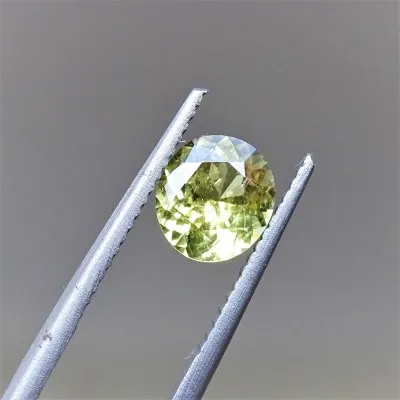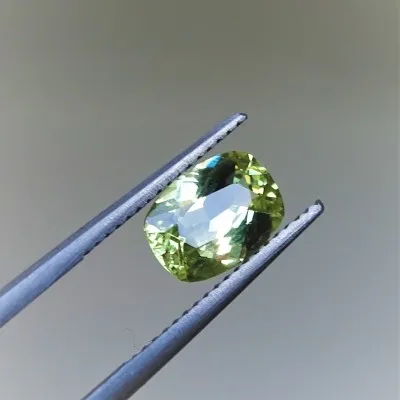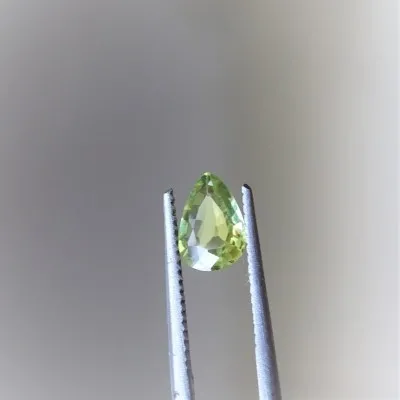
Price
8,900 Kč
In stock
|
COOKIES SETTINGS |
Accept all cookies Personalise |
| Accept selected cookies |



Chrysoberyl – aluminum oxide and beryllium
Chrysoberyl is a mineral with the chemical composition BeAl₂O₄. It typically occurs in yellow-green, green or golden shades and is famous for its high shine and hardness. In jewelry, it is one of the most valued cut stones, also thanks to its rare varieties, such as alexandrite (with a color change depending on the lighting) or “cat’s eye” (with a cat’s eye effect).
Origin and deposits of chrysoberyl
The most important deposits of chrysoberyl are found in Sri Lanka, Brazil, Russia, Tanzania and India. Sri Lankan stones are among the oldest and historically most valued. High-quality crystals are found in Brazil, which are used to produce luxury cut stones.
History and Uses
Chrysoberyl was known in ancient times and, due to its hardness (8.5 on the Mohs scale), became a valued stone for jewelry. The alexandrite variety was discovered in Russia in the 19th century and quickly became one of the rarest gemstones.
Chrysoberyl Identification
Chemical Formula: BeAl₂O₄
Color: yellow-green, green, golden, brown
Crystal Appearance: prismatic, tabular
Crystal System: rhombic (orthorhombic)
Hardness: 8.5 (Mohs scale)
Luster: vitreous
Cleavage: imperfect
Scratch: white
Density: 3.5 – 3.8 g/cm³
There are 4 products.