- New
|
COOKIES SETTINGS |
Accept all cookies Personalise |
| Accept selected cookies |


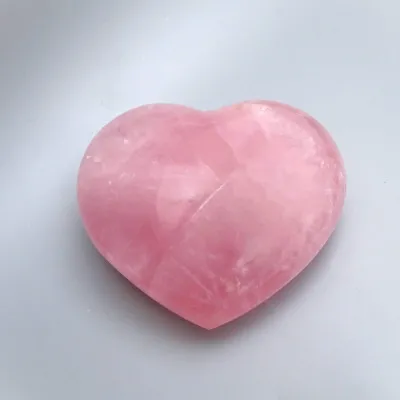
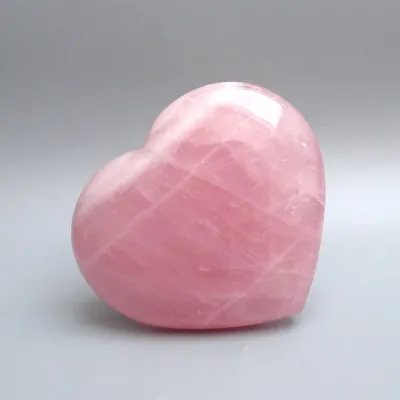
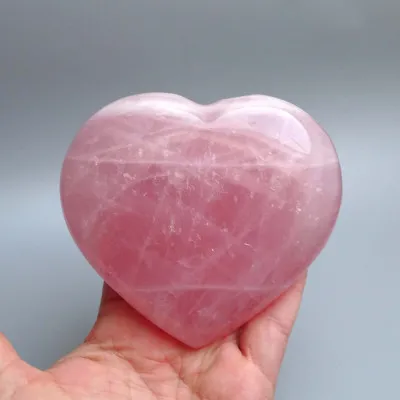
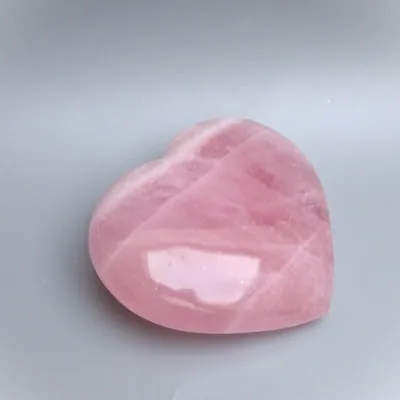
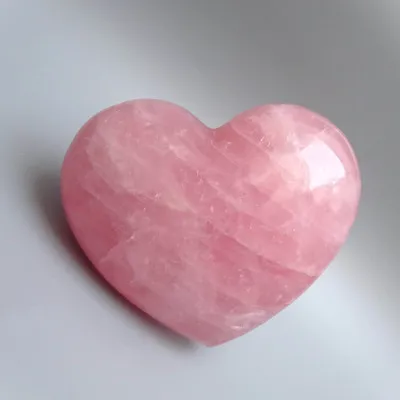
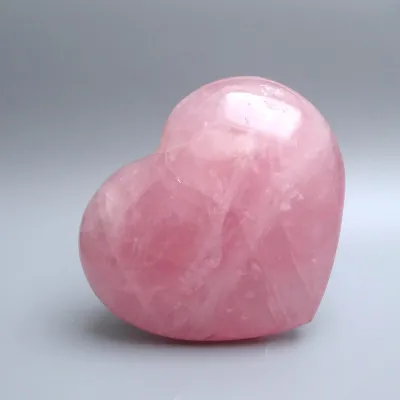
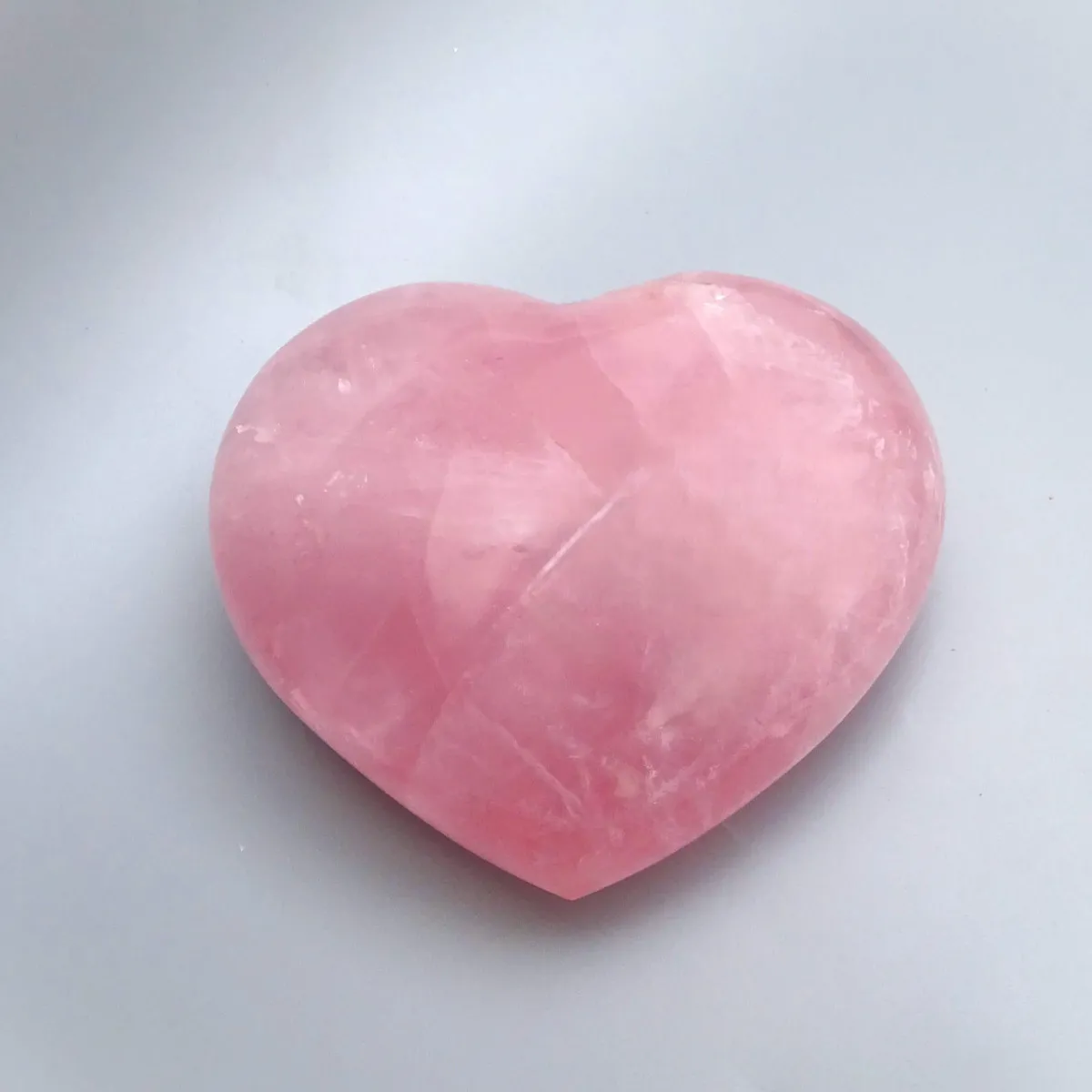
Rose quartz is a translucent to transparent variety of quartz with a pink color. A large rose quartz heart is suitable as a gift, as well as a great interior decoration.
Weight: 540 g
Dimensions: 9.77 x 10.89 x 3.28 cm
Color: light pink
Country of origin: Brazil
You always buy the mineral you see in the photo.
Rose Quartz is among the most beautiful and popular coloured varieties of natural quartz. Its characteristic pink colour, delicate translucency and elegant appearance make it a highly desirable mineral for collectors, natural stone enthusiasts, jewelry designers and admirers of remarkable geological formations.
The colour palette of Rose Quartz ranges from very delicate pastel pink through powdery and dusty rose tones to richer, more intense shades of pink. Some specimens are almost transparent, while others display a characteristic milky or slightly cloudy appearance that gives them a distinctive softness and optical depth.
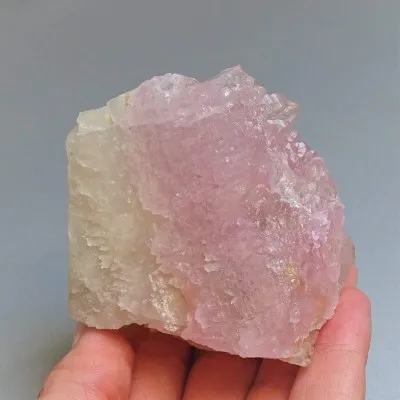
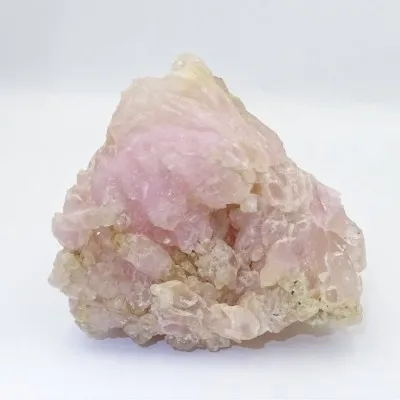
Rose Quartz most commonly occurs as massive, compact aggregates, irregular natural pieces and mineral vein fillings. Unlike Rock Crystal, Amethyst or Smoky Quartz, it generally does not form prominent individual crystals with well-developed crystal faces. This characteristic makes the rare crystalline forms of pink quartz particularly fascinating from a mineralogical perspective.
The beauty of Rose Quartz lies in its natural pink coloration, which becomes particularly attractive in soft daylight or when light passes through translucent sections of the stone.
The origin of its pink colour was historically associated with trace elements, particularly manganese, titanium and iron. However, modern mineralogical and gemological research indicates that the coloration of common massive Rose Quartz is primarily associated with extremely fine fibrous mineral inclusions related to dumortierite.
These microscopic structures may also contribute to the characteristic milky appearance and the scattering of light within the stone. The result is a soft pink glow that distinguishes Rose Quartz from many other coloured minerals.
One of the most fascinating facts about Rose Quartz is that it very rarely forms perfectly developed individual crystals. Common massive aggregates can reach considerable dimensions, but discoveries of pink crystals with clearly defined crystal faces represent an exceptionally unusual mineralogical form.
Well-developed pink quartz crystals may occur as small formations measuring only a few millimetres. However, individual crystals exceeding one centimetre are also known from important localities. Collectors particularly appreciate well-preserved crystal groups, intense colour, transparency and aesthetically pleasing arrangements of individual crystals.
Massive Rose Quartz: The most common form, occurring as compact irregular pieces, vein fillings and massive aggregates. It frequently has a delicate milky appearance and is processed into polished stones, cabochons, spheres, decorative objects and jewelry.
Crystalline Pink Quartz: A much rarer form featuring individual crystals with well-developed crystal faces. Some scientific sources also use the term Pink Quartz for this crystalline variety, as its colour-forming mechanism may differ from that of massive Rose Quartz.
Collector's interest: Among the famous localities for rare pink quartz crystals is the Galiléia region in the Brazilian state of Minas Gerais. High-quality crystal groups displaying intense pink colour and well-preserved crystals are particularly desirable on the mineral collector's market.
Rose Quartz forms primarily in association with granitic pegmatites and hydrothermal processes, during which various forms of quartz and other silicate minerals gradually crystallise from mineral-rich melts and fluids.
Pegmatites are coarse-grained igneous rocks that may contain exceptionally large mineral aggregates. In addition to Rose Quartz, these geological environments may contain Tourmaline, Beryl, Feldspar, Mica, Rock Crystal, Aquamarine and Morganite.
The final appearance of Rose Quartz depends on its formation conditions, the chemical composition of its environment, the presence of microscopic inclusions and subsequent geological processes. Every natural specimen therefore represents a unique combination of colour, translucency, structure and shape.
Brazil – Minas Gerais: One of the world's most important regions for Rose Quartz. Brazil is renowned for producing massive pink quartz as well as exceptionally rare crystalline specimens, particularly from the Galiléia region.
Madagascar: A famous source of attractive Rose Quartz displaying delicate to more intense pink shades. Some specimens exhibit remarkable translucency and are suitable for creating large polished decorative objects or impressive cabochons.
Namibia: A country known for pegmatite occurrences containing Quartz, Tourmaline and other collector minerals, including pink quartz.
Mozambique: A region with significant pegmatite deposits where various quartz varieties and other minerals can be found.
USA – South Dakota: Historically important pegmatite occurrences of Rose Quartz, which is also the official state mineral of South Dakota.
Other localities: Rose Quartz is also known from numerous other regions around the world, including India and several European localities. The significance of an individual discovery depends on its quality, size, colour and crystal formation.
Special attention should be given to Star Rose Quartz, also known as Asteriated Rose Quartz. Under suitable conditions, this stone may display a fascinating optical phenomenon known as asterism – a luminous star that becomes visible when illuminated by a point light source.
This effect is associated with oriented microscopic needle-like or fibrous inclusions within the mineral. In some quartz varieties, Rutile inclusions can contribute to similar optical phenomena. In Rose Quartz, however, fine silicate fibres related to dumortierite may also play an important role.
When Rose Quartz contains appropriately oriented inclusions and is professionally cut into a smoothly domed cabochon, a four-rayed or, more commonly, a six-rayed luminous star may appear under suitable lighting.
A strong, well-centred asterism is a particularly interesting gemological characteristic. High-quality Star Rose Quartz specimens may be desirable among collectors of gemstones exhibiting unusual optical phenomena.
| Mineral | Rose Quartz |
|---|---|
| Mineral species | Quartz – pink variety |
| Chemical formula | SiO₂ – Silicon dioxide |
| Mineral class | Oxides |
| Crystal system | Trigonal |
| Mohs hardness | 7 |
| Colour | Light pink, pastel pink to deep pink |
| Transparency | Translucent to transparent, frequently milky or cloudy |
| Lustre | Vitreous, occasionally greasy on fracture surfaces |
| Cleavage | Poor to indistinct |
| Fracture | Conchoidal |
| Density | Approximately 2.65 g/cm³ |
| Typical appearance | Massive, compact and irregular aggregates |
| Rare form | Well-developed pink quartz crystals |
| Formation | Primarily granitic pegmatites and associated geological processes |
| Important localities | Brazil, Madagascar, Namibia, Mozambique, USA |
| Optical characteristics | Milky appearance, light scattering, rare asterism |
| Applications | Mineral collections, jewelry, cabochons, beads, natural decorations |
Thanks to its delicate colour and excellent workability, Rose Quartz is widely used in the creation of necklaces, pendants, bracelets, earrings, beads and polished cabochons. Its natural pastel-pink coloration harmonises beautifully with silver, gold and minimalist jewelry designs.
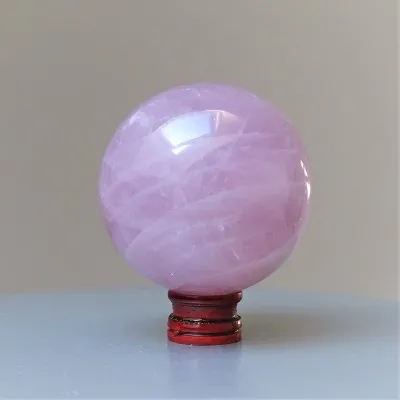
Larger natural Rose Quartz pieces are frequently fashioned into decorative spheres, obelisks, polished freeform sculptures or distinctive interior objects. Rough specimens, on the other hand, allow collectors to admire the authentic structure of the mineral without extensive alteration of its original appearance.
Although massive Rose Quartz is a relatively widespread quartz variety, not all specimens possess the same aesthetic or collector value. Important characteristics include intense and evenly distributed pink coloration, good translucency, unusual shape, size and documented origin from an important mineral locality.
A particularly special position is held by crystalline pink quartz with well-developed crystal faces, which is considerably rarer than the common massive variety. Translucent specimens displaying strong asterism or exceptionally aesthetic natural formations also attract the attention of mineral collectors.
Every Rose Quartz specimen is a unique result of geological development. Its natural colour, internal structure, degree of translucency, mineral inclusions and individual shape create a distinctive appearance that cannot be perfectly reproduced. This authenticity makes natural Rose Quartz an attractive addition to mineralogical collections and original jewelry collections.
Rose Quartz has a hardness of 7 on the Mohs scale. Nevertheless, it should be protected from strong impacts, accidental drops and sudden temperature changes. Quartz may contain natural fractures and internal structures that are part of its geological character.
For cleaning, we recommend a soft cloth or, in the case of compact polished specimens, a slightly damp cloth if necessary. Avoid aggressive chemical cleaning products. To preserve its attractive coloration over time, Rose Quartz should not be exposed to excessive heat or prolonged intense direct sunlight.
Rose Quartz is a pink variety of the mineral Quartz with the chemical formula SiO₂. It most commonly occurs in massive aggregates and is appreciated for its natural pink coloration.
In common massive Rose Quartz, the pink colour is primarily associated with microscopic fibrous inclusions related to dumortierite. Older explanations also referred to various trace elements.
Yes. Well-developed pink quartz crystals are considerably rarer than the ordinary massive form. Important collector's specimens are known, for example, from Minas Gerais in Brazil.
Important sources include Brazil, Madagascar, Namibia, Mozambique and the United States. Individual localities differ in the nature, size and quality of their mineral specimens.
Yes. Some Rose Quartz specimens contain oriented microscopic inclusions that may produce a star-shaped optical effect when properly cut into a cabochon and illuminated. This phenomenon is known as asterism.
No. Most Rose Quartz is translucent to milky or cloudy. Highly transparent, aesthetically attractive material is less common.
Explore more natural minerals, crystals, gemstones and collector's specimens in the collection at MINERALS-STONES®. Discover the fascinating diversity of natural quartz, extraordinary mineral structures and unique stones from around the world.
MINERALS-STONES® – the exceptional beauty of natural minerals. 1 piece = 1 original.
Every natural Rose Quartz specimen is a unique mineral original with individual colour, internal structure and natural patterns. For individually photographed products, the product photographs show the actual specimen offered for sale.
Rose quartz is a translucent to transparent variety of quartz with a pink color. A large rose quartz heart is suitable as a gift, as well as a great interior decoration.
Weight: 540 g
Dimensions: 9.77 x 10.89 x 3.28 cm
Color: light pink
Country of origin: Brazil
You always buy the mineral you see in the photo.