- New
|
COOKIES SETTINGS |
Accept all cookies Personalise |
| Accept selected cookies |


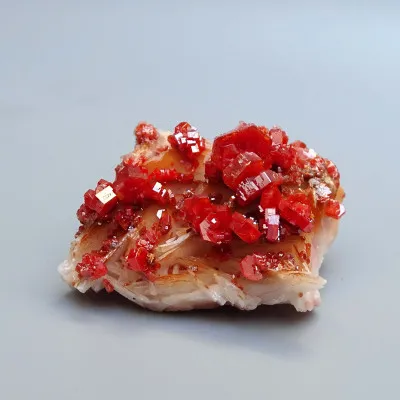
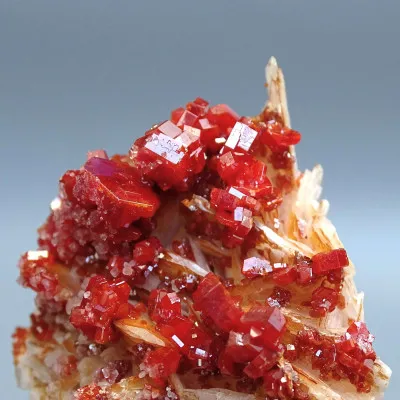
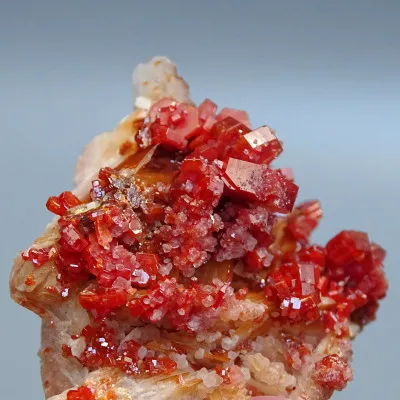
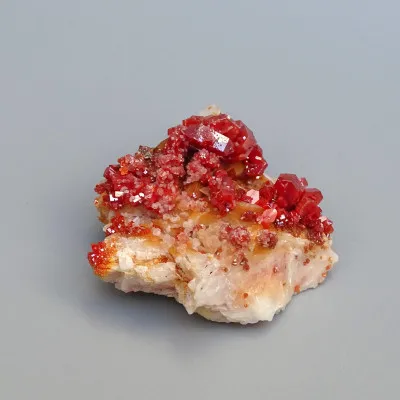
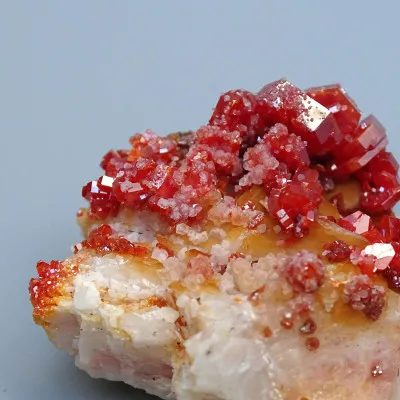
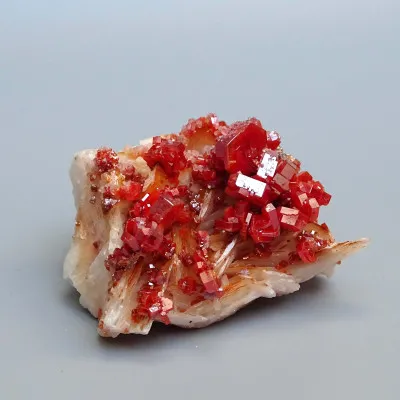
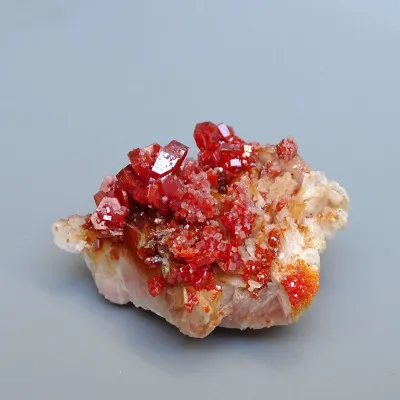
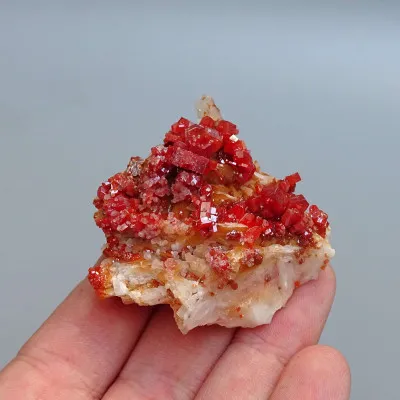
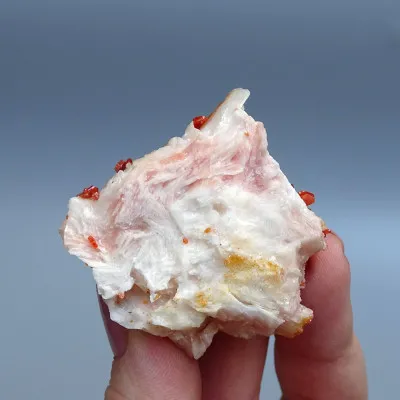
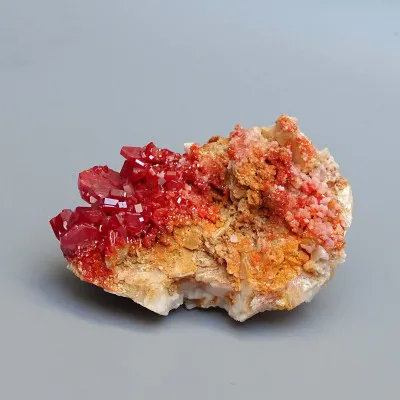
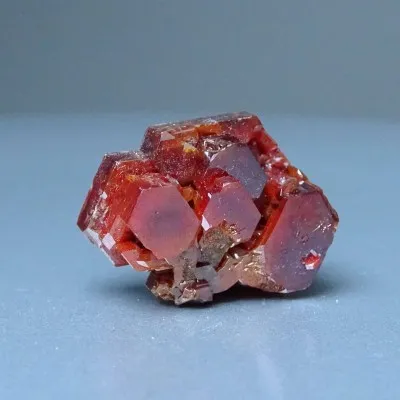
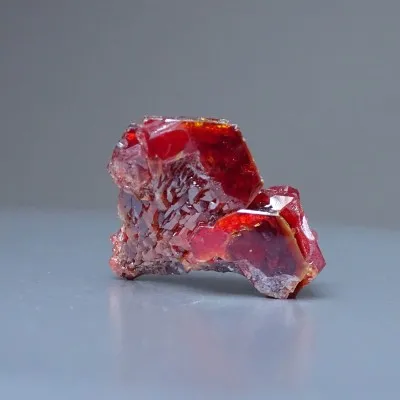
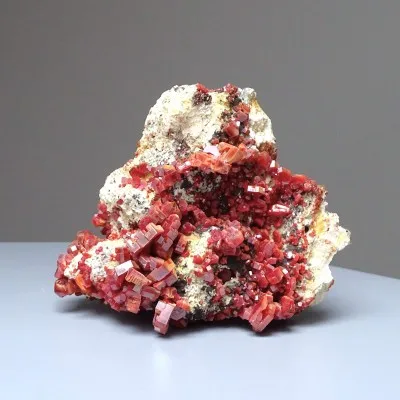
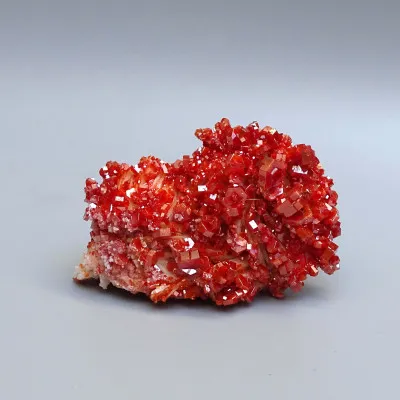
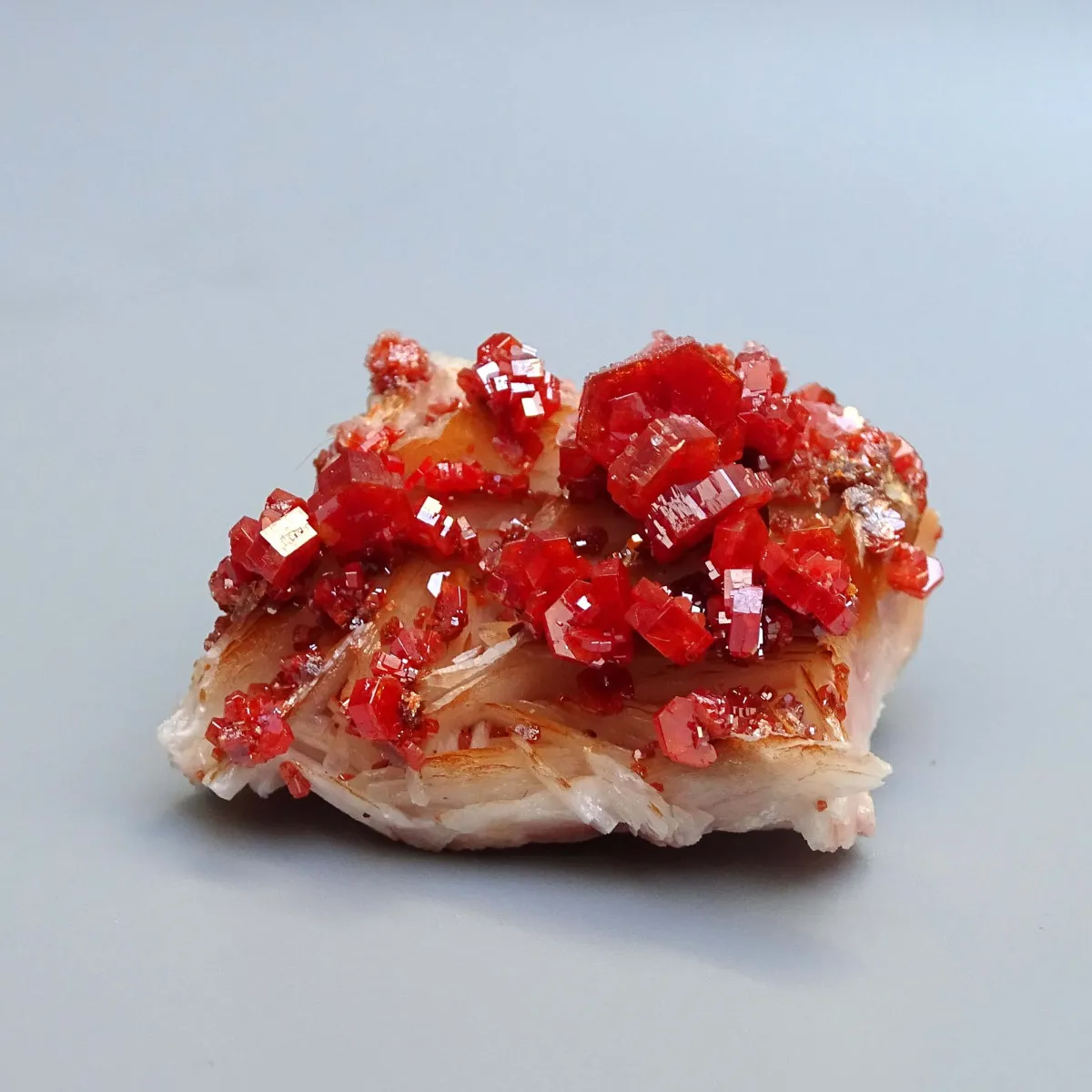
Vanadinite pure crystals beautiful color in combination with barite, Top quality, collector's item. Vanadinite is a fascinating mineral, which is characterized by its deep red, orange or brown color and characteristic hexagonal crystals. It belongs to the phosphate group and is an important source of vanadium. It is popular among mineral collectors due to its crystalline structure and vibrant colors.
Weight: 65 g
Stone size: 4.58 x 4.11 x 2.95
Country of origin: Morocco - Mibladen locality near Midelt
You are buying the mineral shown in the photo.
Vanadinite is among the most attractive secondary minerals containing vanadium and lead. Its extraordinary beauty lies primarily in its intensely red, orange to reddish-brown crystals, which often form perfectly developed six-sided prisms with a remarkable lustre.
At first glance, Vanadinite captivates with its fascinating combination of fiery coloration, regular geometric crystallisation and striking contrast with the host rock. Individual crystals may form rich crystal druses, compact aggregates and exceptionally beautiful groups resembling tiny red gemstones scattered across the surface of the rock.
Particularly prized are specimens displaying well-developed, undamaged crystals, intense colour, natural lustre and an aesthetically pleasing arrangement. These characteristics make Vanadinite a highly desirable collector's mineral and an impressive display specimen in mineralogical collections worldwide.
The most striking characteristic of Vanadinite is its intense coloration in shades of red, orange-red, brick red, reddish-brown and honey yellow. Depending on the specific conditions of formation and chemical composition, the colour of individual crystals can vary considerably.
The crystals frequently exhibit a strong resinous to adamantine lustre, further enhancing their natural geometric structure. Under suitable lighting, some crystals may appear almost like tiny glowing gemstones.
The combination of regular crystal faces and pronounced red-orange coloration creates an exceptionally impressive natural contrast. This distinctive aesthetic makes high-quality Vanadinite druses popular display specimens in mineral collections.
Vanadinite crystallises in the hexagonal crystal system. Well-developed six-sided prismatic crystals are typical, often terminated by flat basal faces. Some crystals are short and thick, resembling small hexagonal plates, while others develop more elongated prismatic forms.
A single natural specimen may contain numerous crystals of different sizes growing from the host rock in various directions. Their arrangement creates rich three-dimensional crystal groups and druses, whose appearance differs from one specimen to another.
The distinctive six-sided geometry is an important identifying characteristic of Vanadinite. Well-preserved crystal faces, the regularity of individual prisms, their terminations and their overall aesthetic appearance are significant criteria in collector evaluations.
Regular geometry: Vanadinite naturally forms hexagonal crystals whose shape originates from the mineral's internal atomic arrangement.
Variety of crystal forms: Crystals may be short-prismatic, tabular or distinctly elongated and prismatic.
Crystal groups: Individual crystals may form dense druses, irregular aggregates or prominent single crystals growing on the host rock.
Collector appeal: The contrast between bright red crystals and the light or dark host rock on which they grow is particularly desirable.
Vanadinite is a lead chlorovanadate with the chemical formula Pb₅(VO₄)₃Cl. It consists of lead, vanadium, oxygen and chlorine and belongs to the mineral class of phosphates, arsenates and vanadates.
Based on its crystal structure, Vanadinite belongs to the apatite group of minerals. It is structurally related to minerals such as pyromorphite and mimetite, which may form under similar geological conditions in certain deposits.
Compared with many common silicate minerals, Vanadinite has a relatively high density of approximately 6.9 g/cm³, which is associated with the significant proportion of lead in its chemical composition.
Although its crystals may appear compact, Vanadinite is a relatively soft and brittle mineral. Its hardness is generally reported as approximately 2.5–3 on the Mohs scale, making careful handling essential.
Vanadinite belongs to the secondary minerals found in the oxidation zones of lead ore deposits. It forms through geological and chemical processes involving the alteration of original ore minerals.
The oxidation of lead-bearing minerals, such as galena (PbS), may play an important role. The released lead can subsequently react with vanadate components in mineral-bearing solutions, allowing Vanadinite to form under suitable conditions.
This process occurs particularly near the Earth's surface, where ore-bearing rocks come into contact with oxygen, water and other chemically active components of their environment.
Vanadinite is therefore often found in association with other secondary minerals from lead ore deposits. Its formation provides evidence of the fascinating geochemical history of the original ore body.
Morocco is among the world's best-known sources of exceptionally beautiful Vanadinite crystals. Moroccan specimens are particularly famous for their intense red to orange-red coloration, rich crystallisation and beautifully preserved hexagonal crystals.
Among the most important Moroccan localities is Mibladen in the Midelt region, where attractive Vanadinite druses, individual crystals and crystal groups occur on various types of host rock.
Some Moroccan specimens display a beautiful contrast with their matrix, for example calcite or other associated minerals. Regular six-sided crystals form striking natural compositions that are particularly popular among collectors.
The Mibladen area of Morocco has gained international recognition for its exceptionally aesthetic Vanadinite specimens. Its discoveries are especially characterised by brilliant red crystals, intense lustre and rich hexagonal crystal druses.
High-quality Vanadinite from Morocco is an attractive addition to mineralogical collections. Specimens with undamaged crystals, intense coloration and naturally balanced compositions receive particular attention.
Morocco: The famous Mibladen area and other ore deposits produce aesthetically attractive red to orange-red crystals, frequently growing in rich groups on their host rock.
Mexico: A historically important country for Vanadinite occurrences. Zimapán in Hidalgo State is the type locality of this mineral species.
Namibia: Ore deposits, including the famous Tsumeb area, have produced numerous secondary minerals, including Vanadinite.
USA: Vanadinite is known from several ore deposits, particularly in Arizona and New Mexico, where it forms in the oxidation zones of lead ores.
Other worldwide occurrences: Vanadinite is also found in additional regions with suitable geochemical conditions. The quality of specimens varies according to locality, crystal development, colour and mode of occurrence.
| Mineral | Vanadinite |
|---|---|
| Chemical formula | Pb₅(VO₄)₃Cl |
| Chemical composition | Lead chlorovanadate |
| Mineral class | Vanadates – phosphates, arsenates and vanadates |
| Mineral group | Apatite group |
| Crystal system | Hexagonal |
| Mohs hardness | 2.5–3 |
| Density | Approximately 6.9 g/cm³ |
| Colour | Red, orange-red, reddish-brown, brown to yellow |
| Transparency | Translucent to opaque |
| Lustre | Resinous to adamantine |
| Typical crystal habit | Six-sided prismatic and short-prismatic crystals |
| Crystal aggregates | Druses, aggregates, coatings and crystal groups |
| Cleavage | Indistinct to unobservable |
| Mechanical properties | Brittle mineral |
| Formation | Secondary mineral formed in oxidation zones of lead ore deposits |
| Associated minerals | For example, calcite, galena, cerussite and other ore or secondary minerals |
| Important localities | Morocco, Mexico, Namibia, USA |
| Uses | Mineralogical collections, collector's specimens, study of secondary minerals |
High-quality Vanadinite is popular among collectors because of its attractive crystallisation, intense coloration and remarkable lustre. However, each specimen may differ in quality and collector significance.
The most important evaluation criteria include the size and preservation of individual crystals, colour intensity, regularity of hexagonal crystal faces, natural contrast with the host rock, locality and overall composition.
Specimens featuring prominent undamaged crystals or rich crystal druses are particularly admired, especially when their regular geometry and fiery colours complement each other naturally. Such pieces can become striking display specimens in private mineralogical collections.
Vanadinite is a beautiful example of nature's ability to create surprisingly regular geometric forms. Six-sided crystals in red and orange shades appear almost like perfectly cut miniature gemstones, even though they were formed entirely through natural geological processes.
Particularly interesting are specimens in which smaller crystals alternate with larger, dominant prisms. Their combination creates a remarkable sense of depth, three-dimensional structure and visual dynamism within the entire mineral group.
Vanadinite therefore appeals not only to experienced mineralogists but also to enthusiasts of natural structures, crystal geometry and aesthetically impressive collector's minerals.
Vanadinite combines intense natural coloration, precise hexagonal crystallisation, remarkable lustre and a fascinating geological origin. Every crystal druse and crystal group is a unique natural composition that cannot be perfectly reproduced. This combination makes Vanadinite an exceptionally attractive collector's mineral.
Vanadinite is a relatively soft and brittle mineral, so its crystals should be protected from impacts, falls, abrasion and careless handling. Well-developed six-sided crystals may have particularly delicate edges and terminations.
For dust removal, we recommend using only a very soft, dry brush or careful non-contact cleaning. Soaking in water, ultrasonic cleaning, aggressive chemicals and mechanical scrubbing should be avoided.
Vanadinite naturally contains lead and vanadium. It is a collector's mineral intended for display and scientific study, not for direct contact with food or drinking water, or for preparing so-called mineral elixirs.
Wash your hands after handling the mineral, avoid generating or inhaling mineral dust, and keep it out of reach of young children and pets. For safe display, we recommend using a closed mineral display cabinet.
Vanadinite is a secondary mineral containing lead, vanadium and chlorine. It has the chemical formula Pb₅(VO₄)₃Cl and belongs to the apatite group. It is best known for its intensely red to orange hexagonal crystals.
Vanadinite crystallises in the hexagonal crystal system. Its internal atomic arrangement allows the formation of regular six-sided prismatic and short-prismatic crystals.
One of the most famous localities is Mibladen in Morocco. Vanadinite is also known from Mexico, Namibia and the USA. Moroccan specimens are especially prized for their intensely red crystals and rich crystallisation.
Vanadinite mainly forms in the oxidation zones of lead ore deposits. During chemical alteration of original ore minerals, lead is released and may react with vanadate-bearing components under suitable conditions.
Vanadinite has a hardness of approximately 2.5–3 on the Mohs scale. It is relatively soft and brittle, so its crystals require careful handling.
Vanadinite is one of the less common secondary minerals, although it is known from several ore deposits worldwide. Its collector value is strongly influenced by the size, aesthetic appearance, quality and preservation of its crystals.
Yes. Thanks to its intense coloration and regular hexagonal crystals, Vanadinite is among the most attractive collector's minerals. Displaying it in a protected cabinet is recommended.
Because Vanadinite contains lead, unnecessary direct contact should be minimised. Avoid creating mineral dust and wash your hands after handling. The mineral is not intended for consumption or for preparing drinking water.
Discover more fascinating natural minerals, crystal druses and collector's specimens in the collection at MINERALS-STONES®. Explore the fascinating geometry of natural crystals, exceptional mineral structures and rare stones from around the world.
MINERALS-STONES® – the fascinating world of natural minerals. 1 piece = 1 original.
Every natural Vanadinite is a unique mineral specimen with its own individual colour, crystallisation, structure and aesthetic character. For individually photographed products, the product images show the actual original specimen offered for sale.
Vanadinite pure crystals beautiful color in combination with barite, Top quality, collector's item. Vanadinite is a fascinating mineral, which is characterized by its deep red, orange or brown color and characteristic hexagonal crystals. It belongs to the phosphate group and is an important source of vanadium. It is popular among mineral collectors due to its crystalline structure and vibrant colors.
Weight: 65 g
Stone size: 4.58 x 4.11 x 2.95
Country of origin: Morocco - Mibladen locality near Midelt
You are buying the mineral shown in the photo.