- There are no more items in your cart
- Shipping
- Total $0.00
- ACTIONS - DISCOUNTS
- Beads from Minerals
- Cut stones - gemstones
- Alexandrite – a gemstone with variable color
- Amethyst cut stone
- Ametrine – a mineral with a combination of purple and yellow colors
- Aquamarine – a gemstone of blue hues
- Chrysoberyl – a gemstone of yellow-green hues
- Citrine
- Emerald – a green beryl gemstone
- Garnet
- Heliodor (golden beryl)
- Kunzite
- Mix other cut stones
- Moonstone – a gemstone with a pearly sheen
- Morganite
- Olivine (peridot)
- Opal
- Ruby
- Sapphire cut stones
- Blue sapphire – a gemstone from Sri Lanka
- Green sapphire – a gemstone from Sri Lanka
- Padparadscha sapphire – a rare gemstone from Sri Lanka
- Pink sapphire – a gemstone from Sri Lanka
- Star sapphire – a sapphire with a star on the surface
- White sapphire – a gemstone from Sri Lanka
- Yellow sapphire – a gemstone from Sri Lanka
- Sinhalite
- Smokyquartz
- Spinel gemstone
- Sunstone
- Tanzanite – a rare gemstone
- Topaz
- Tourmaline
- Zircon
- Exclusive collection crystals and minerals
- Natural raw stones and minerals
- Afghanite
- Agate
- Amber
- Amethyst
- Ametrine
- Andean opal - blue
- Andean opal - pink
- Angelite
- Apatit
- APOPHYLITE, STILBITE, ZEOLITE
- Aquamarine
- Aragonite
- Astrophyllite
- Auralite
- Axinite
- Azurite
- Baryte
- Brazilianite
- Calcite
- Carneol
- Cavansite
- Celestine
- Chalcedony
- Charoite
- Chromdiopside
- Chrysocolla
- CHRYSOCOLLA - MALACHITE - AZURITE
- Chrysopras
- Citrine
- Clinoatacamite
- Cobaltocalcite
- Colombianite
- Copper
- Cyanite
- Danburite
- Diopside
- Dioptase
- Dolomite
- Dumortierite
- Emerald
- Eudialyte
- Fluorite
- Garnet
- Grape chalcedony
- Hackmanite
- Haüyn/Hauyne green (sodalite)
- Haüyn/hauynite blue (sodalite)
- Heliodor (golden beryl)
- Hemimorphite
- Hidennite
- Iolite / cordierite
- Jade
- Jasper
- K2 - Azurite in granite
- Kunzite
- Labradorite
- Lapis lazuli/lazurite
- Larimar
- Lemurian quartz
- Libyan desert glass
- Lodolite (quartz crystal with inclusions)
- Malachite
- Meteorite
- Moldavite
- Moonstone/adularia
- Moqui marbles
- Morganite
- Natural mussels (freshwater mussels)
- Nefrite
- Nuummite
- Obsidian
- Olivine (peridote)
- Opal - dendritic (merlinite)
- Opal Ethiopian
- Pentagonite rare blue mineral
- Petalite
- Phenacite/Phenakite
- Phosphosiderite
- Pietersite
- Pollucite
- Prehnite
- Pyrite
- Quantum quattro
- Quartz - cut or polished
- Quartz/crystal - raw
- Rhodochrosite
- Rhodonite
- Roselite
- Rosequartz
- Rubelit/red tourmaline
- Ruby
- Ruby in zoisite
- Sagenit (Venus hair)
- Sapphire
- Scolecite
- Scoryl
- Selenite
- Seraphinite
- Shungite
- Skapolite
- Smoky quartz
- Smokyquartz with rutile
- Sphalerite
- Spinel
- Sugilite
- Sunstone
- Sunstone with iolite
- Superseven (Super 7)
- Tanzanite gemstone
- Tektite
- Tektite Agni Manitite
- Thulit
- Tiger´s eye
- Titanite/sphene
- Topaz
- Tourmaline
- Triplite
- Tugtupit
- Turquoise
- Vanadinite
- Vesuvianite (Idokras)
- Zircon
- Original handmade mineral jewelry
- Mineral beads bracelets
- Other jewelry
- Silver and gemstone jewelry
- Abalone/Paua shell
- Aquamarine pendant
- Astrophyllite pendant
- Azurite pendant
- Azurite-malachite-chrysocol
- Black tourmaline (scoryl)
- Cavansite
- Charoite pendant
- Chrysoprase pendant
- Cobaltocalcite pendants
- Dendritic opal
- Ethiopian opal pendant
- Eudialyte pendant
- Kunzite and hiddenite
- Labradorite pendant
- Larimar jewelry
- Malachite jewelry
- Moldavite
- Moonstone jewelry
- Morganite jewelry
- Nuummite
- Obsidian pendants
- Olivine/Peridot
- Pietersite jewelry
- Quantum Quattro jewelry
- Rhodochrosite
- Ruby
- Sagenit
- Seraphinite jewelry
- Sugilite
- Sunstone jewelry
- Turquoise jewelry
Diopside
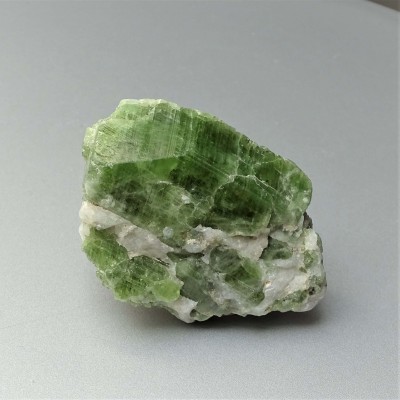
Diopside (hardness between 5.5 and 6.5) is an important rock-forming mineral from the group of monoclinic pyroxenes. Its color varies based on the presence of the chemical elements magnesium or calcium and can therefore be found from a colorless variety to a beautiful deep green, then in the color of milky white, gray and in the case of violane the color is even purple. It has a glassy luster, transparency: translucent to opaque, scratch is white. Its name, originating from the Greek, is composed of two words dis and òpsè, which literally means two faces. Diopside was first discovered and described around 1800.
Diopside – a mineral from the group of pyroxenes
Diopside is a calcium and magnesium silicate with the chemical formula CaMgSi₂O₆. It belongs to the group of pyroxenes and is known for its diverse color, most often in shades of green, brown or white.
Appearance and properties of diopside
Diopside crystallizes in the clinker system and often forms prismatic crystals. The hardness ranges between 5.5–6.5 on the Mohs scale. Some varieties of diopside, such as chrome diopside, stand out with an intense emerald green color.
Diopside deposits
Significant deposits of diopside are found in Russia (Siberia – famous chrome diopside), Canada, Pakistan, Afghanistan and Italy. Samples are also found in metamorphic rocks around the world.
History and uses of diopside
Diopside was described at the beginning of the 19th century. It is valued mainly among mineral collectors. Some clear and colorful varieties are also used in jewelry as gemstones.
You always buy the mineral shown in the photo. Minerals-stones.com – a wide range of minerals, crystals, stones, druses, tektites, jewelry and gemstones from around the world. Reliable, verified e-shop.